A Bonita research guide
How to read cosmetic surgery before-and-after photos
A before-and-after pair can start a useful conversation, but it cannot tell you what will happen to your body. Look at how the pictures were made, what they claim to show and what remains unknown.
By Bonita Index editorial research · Updated
AI-assisted source research. No independent clinical review is claimed. How we work · Suggest a correction
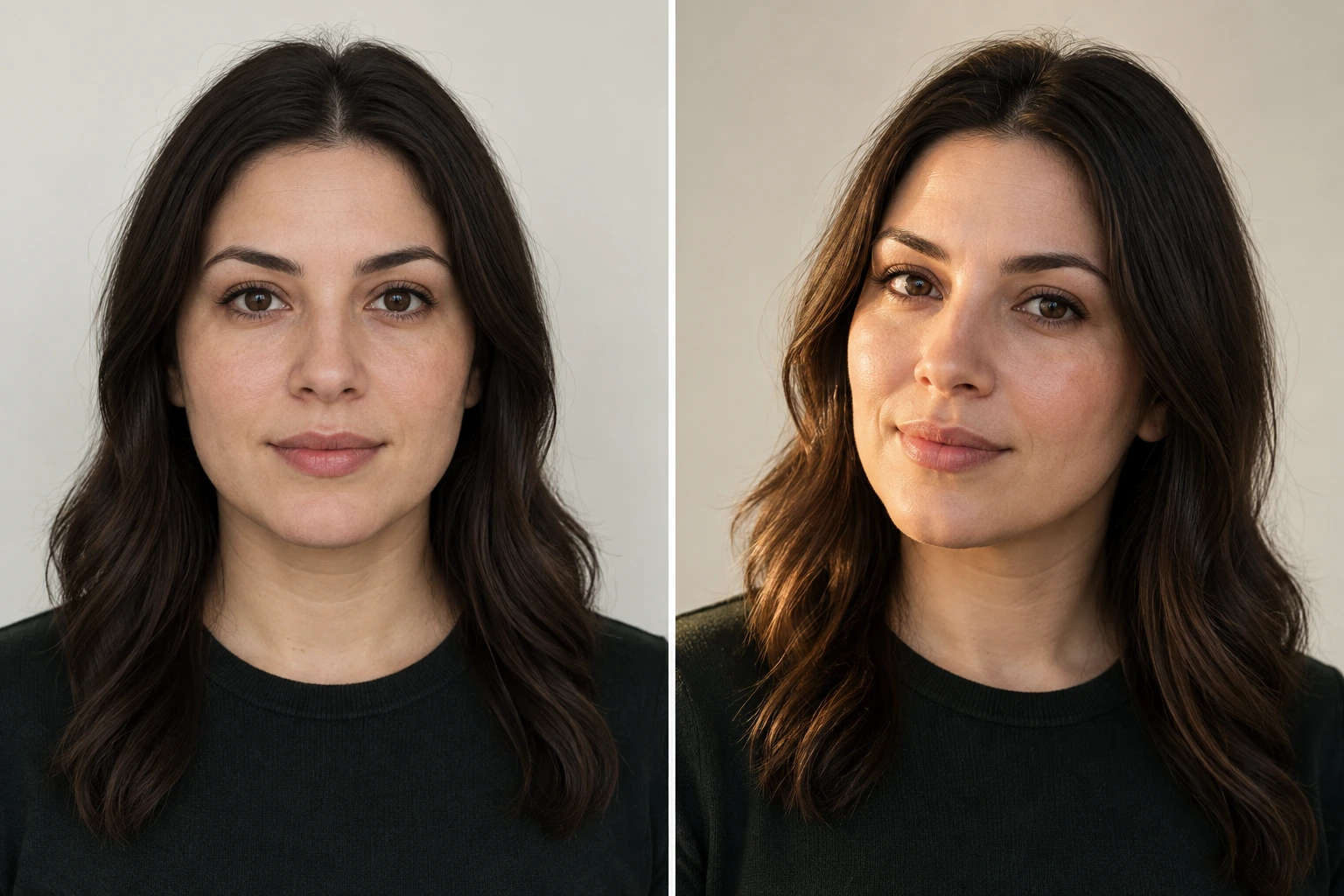 AI-generated illustration
Start with the claim
Read the caption. Which procedure is named, who says they performed it, and how long after treatment was the second image taken? A photo alone cannot establish any of those facts. Ask the practice to explain the context.
Compare the camera conditions
Check whether the person is in the same pose and whether the camera angle, distance, lighting, background, clothing and makeup are comparable. Differences do not prove deception, but they can make the apparent change harder to judge. The generated example above shows only a change in presentation.
Ask about editing and timing
Look for signs of filters or retouching and ask whether the images were edited. Ask when each photograph was taken and whether the gallery shows early healing or a later result. People heal differently, so another person’s timeline is not your own.
Remember what the gallery leaves out
Practices may select their strongest examples. A few images do not establish a typical outcome or the clinician’s full experience. Ask what range of outcomes and limitations is relevant to your own goals, and discuss that with a qualified clinician.
Research the care behind the image
A photograph does not verify professional registration, specialty, the operating facility or the follow-up plan. Check those separately. If an image appears on more than one account, trace its source before assuming who performed the work. Do not repost identifying patient images without permission.
Sources to open
- American Society of Plastic Surgeons: Can you trust before and after photos? (opens a new tab)
- NHS: Before you have a cosmetic procedure (opens a new tab)
- ASA/CAP: Cosmetic surgery advertising guidance (opens a new tab)
This is research education, not individualized medical advice.